The Hairstreak

An 'Exmoor Ponies in Conservation' project
Other butterflies seen on Myers Allotment
Hairstreak
common name for any member of a group of butterflies belonging to the family Lycaenidae, which also includes the blues and coppers. Hairstreaks are usually quite small with wingspans ranging from 2.5 to 6 cm. The name “hairstreak” is derived from the fine pattern of lines on the undersides of the wings of most species. In the early days of butterfly study they were referred to simply as “streaks”. The uppersides of the wings are often brilliantly coloured, particularly in tropical species such as Hewitson’s blue hairstreak from South America. However, most species from temperate climates are less brightly coloured, although some, such as the green hairstreak from Europe, have an unusual metallic green colour to the undersides of the wings.
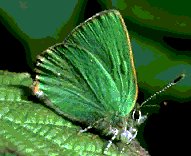
The green hairstreak, found throughout Europe,
has wings that are brown on the upperside and bright green on the underside.
It feeds on nectar from flowers and honeydew.
It rests among leaves with its wings folded up,
exposing the green undersides and providing good camouflage.
The hindwings of many hairstreak butterflies have fine tail-like projections which, in some species, are very long and conspicuous. Coupled with strategically placed dark “eye-spots” on the undersides of the hindwings, they create the appearance of a false head when the butterfly is at rest, the tails representing false antennae If a bird attacks the false head, the butterfly is able to escape with the minimum of damage.
Hairstreak caterpillars are variable, but many are short and slug-like. They feed on plant matter, although some are cannibalistic. A number of them have a symbiotic relationship with ants, secreting a sweet substance for the ants in return for protection.
Scientific classification: Hairstreaks belong to the family Lycaenidae. The Hewitson’s blue hairstreak is classified as Thecla coronata and the green hairstreak as Callophryrs rubi.


