The Brimstone

An 'Exmoor Ponies in Conservation' project
Other butterflies seen on Myers Allotment
Brimstone
common name for a distinctive butterfly that is widely distributed throughout Europe, except in northern Scandinavia and Scotland, and ranges south to northern Africa and eastward to Japan. Males are bright yellow and females are greenish-white, and both sexes have small orange-red dots in the centre of each wing. The wings are distinctively shaped and present a leaf-like appearance when the butterfly settles on a twig or stem. They have a wingspan of 5.5 to 6.5 cm (2 in). An early English name for this insect was the “butter-coloured fly”, which is probably the source of the name “butterfly”.
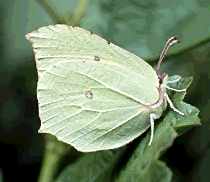
Brimstone butterflies hibernate and emerge in spring.
They are found throughout Europe along hedgerows
and in woodland clearings and open countryside.
They always rest with their wings up,
the colouring and shape of which give them the appearance of leaves.
Brimstone caterpillars are green with an indistinct whitish line along the sides. In chalk and limestone regions they feed on the foliage of buckthorn, while in wet or acidic areas they feed on alder buckthorn. They become fully grown in about one month and then pupate on the undersides of leaves or the stems of low-growing vegetation. Adult butterflies emerge in summer and are active for a few weeks before going into hibernation, often seeking shelter among ivy leaves where they are well camouflaged. Early in the following spring, they emerge to feed, mate, and lay eggs on newly developed foliage of the food plants. The brimstone butterfly has a lifespan of 10 to 11 months, which is one of the longest of indigenous British butterflies.
The brimstone is often the first butterfly to be seen in parks and gardens in springtime. Although it is most commonly seen in large numbers where the caterpillars’ food plant grows, it is a very mobile butterfly and may be seen almost anywhere in hedgerows, woodland clearings, and open countryside. Adult butterflies feed on a variety of nectar-rich flowers, particularly thistles, teasels, and buddleia.
Scientific classification: The brimstone butterfly belongs to the family Pieridae and is classified as Gonepteryx rhamni.


