The Peacock

An 'Exmoor Ponies in Conservation' project
Other butterflies seen on Myers Allotment
The Peacock
common name for a large butterfly widespread in Britain and ranging throughout western Europe and temperate Asia. The upper surfaces of its wings are chocolate brown, with prominent purple eyespots on the hindwings. Seen upside-down, the pattern bears a remarkable resemblance to an owl's face. When threatened, the peacock butterfly flashes its wings open and makes a rustling sound by rubbing them together. The undersurfaces of the wings are a mottled grey-brown, providing excellent camouflage when the insect rests on bark.
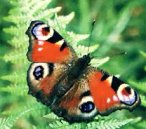
The conspicuous eyespot markings of the peacock butterfly,
make the insect unmistakable.
The butterfly uses its patterning in self-defence,
opening its wings if threatened by a bird and
attempting to alarm the attacker by turning the pattern towards it,
and even making a noise by rubbing its wings together.
Female peacock butterflies mate and lay their eggs on stinging nettles in March, April, and May. The larvae (caterpillars) that emerge feed on the nettles, moulting several times as they grow. They pupate among the nettle leaves, and the adults begin to emerge in late July. Adults may live for up to 11 months, hibernating in crevices and hollow trees over winter.
Scientific classification: The peacock butterfly belongs to the family Nymphalidae. It is classified as Inachis io.


