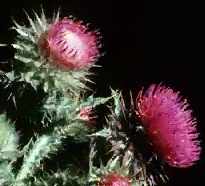

Thistle
Thistle, common name for many plants of the daisy family, all possessing spiny leaves or stems and often with sharp, spiny bracts (modified leaves) surrounding the flower heads. The name is also commonly used for other prickly plants. True thistles belong to two genera. They are all spiny, with purple, or occasionally white, flower heads and are common plants of meadows, banks, and waste ground. One genus of true thistles includes the creeping thistle, which has spiny leaves but spineless stems and spreads rapidly by far-creeping, underground stems; the dwarf thistle, which usually completely lacks a stem and appears as a rosette of spiny leaves with a cluster of flowers in the centre; and the spear thistle, which is the plant used as the emblem of Scotland. The second genus of true thistles includes the musk thistle, which is common in fields throughout Europe and has large, drooping flower heads, and the welted thistle, which has stems up to 1.5 m (5 ft) high with continuous, spiny wings running from top to bottom.
Scientific classification: Most thistles belong to the family Asteraceae (or Compositae). True thistles make up the genera Cirsium and Carduus. The creeping thistle is classified as Cirsium arvense, the dwarf thistle as Cirsium acaule, the spear thistle as Cirsium vulgare, the musk thistle as Carduus nutans, and the welted thistle as Carduus crispus. The cotton thistle is classified as Onopordum acanthium, the milk thistle as Silybum marianum, and the golden thistle as Scolymus hispanicus. Globe thistles make up the genus Echinops and sow thistles make up the genus Sonchus.
 |  |  |