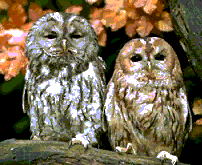
A Tawny Owl

The large eyes of owls (smaller in barn owls) are directed forwards for binocular vision, and are encased in a capsule of bone called the sclerotic ring, which allows little eye movement. Owls must turn their entire heads to look sideways, facilitated by relatively long and flexible necks that permit the head to be rotated through 270 degrees. In most owls the eyes are surrounded by a facial disc of stiff feathers. Barn owls have distinctive heart-shaped faces and no ear tufts. As relatively few owls hunt their prey in full daylight, their hearing is particularly important. The soft texture and arrangement of their feathers renders flight almost noiseless, making it easier for them to surprise their prey. Many owls have asymmetrical skulls, with the ear openings at different levels; this enables the bird to get a “fix” on the sound made by a prey animal. Sharp talons and a strong, hooked beak are used to grasp the quarry.
Owls range over the whole globe except in the Antarctic region; the common barn owl has one of the largest ranges among living birds. The nesting habits of owls are highly variable. Some nest in holes in trees or among rocks, others nest in large tree-nests, and others, such as burrowing owls, nest on the ground. All lay white eggs. Owls feed entirely on living animals, with the size of the prey proportional to the size of the owl, from insects to mammals as large as hares. A few feed primarily on fish. They usually swallow their prey whole. Indigestible portions of their food, such as bones, hair, and feathers, are compressed and regurgitated as compact pellets; analysis of pellet contents identifies the prey species.
Some genera of owls have many species—the largest genus, otus, contains more than 35. Some owls of this genus are well known, such as the eastern screech owl of eastern North America and the Eurasian scops owl, a strongly migratory species that breeds in southern Europe as far east as Lake Baikal. Many of the tropical species, however, are known from only a few museum specimens, and their habits have not been studied. All species belonging to the largest genus of owls look much alike and, as might be expected in nocturnal birds, are differentiated most strongly by their distinctive voices. Owls may hoot, whistle, screech, or click and they are particularly noisy while courting.
Among the largest species of owls are the eagle owls. They have tufts of feathers on their heads that are called “ears” but are not related to true ears. There are several species in Europe, Africa, and Asia but only the great horned owl is found in the Americas. Most widely distributed is the northern eagle owl, found from Scandinavia and Spain to Japan. It is about 71 cm (28 in) long. The snowy owl of northern Eurasia, in which the female is white with few black spots on the back and the male pure white, is unusual in feeding by day (mostly on lemmings). The northern hawk owl is also a daytime hunter.
Tawny Owl
Owl, common name for members of an order of nocturnal birds of prey. There are two families: the typical owls, with about 122 species; and the barn owls, with about 12 species. There are anatomical differences between the two families, but many generalizations apply to both.
A Tawny Owl
 |