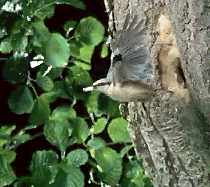
A nuthatch

Nuthatch
Nuthatch, common name for about 20 species of passerine (able to perch) birds, widely distributed in the northern hemisphere. In Europe and the Americas they are strictly temperate, extending south to Mexico only in the highlands, but in Asia-where nuthatches are more diverse-there are several tropical species. Nuthatches are noted for their arboreal dexterity. Their tails are not modified as stiff props as they are in woodpeckers, but nuthatches nevertheless move about on vertical surfaces of tree trunks and even on the undersides of branches, using their powerful feet and long claws; they are the only tree-climbing birds that move head downwards. They probe the bark for adult insects, larvae, and eggs. They also feed on grain and nuts, breaking them by pecking at the hard outer coatings with their bills. Nuthatches nest in natural crevices or nest holes abandoned by woodpeckers or other birds. The nest is lined with bits of bark, hair, grass, and feathers. The European nuthatch may use mud to reduce the size of an oversize nest hole. The western rock nuthatch, of eastern Europe, is untypical in that it lives among cliffs and ruined buildings.
A nuthatch
Scientific classification: Nuthatches belong to the family Sittidae of the order Passeriformes. The European nuthatch is classified as Sitta europea, the western rock nuthatch as Sitta neumayer, the white-breasted nuthatch as Sitta carolinensis, the red-breasted nuthatch as Sitta canadensis, the pygmy nuthatch as Sitta pygmaea, and the brown-headed nuthatch as Sitta pusilla.
 |