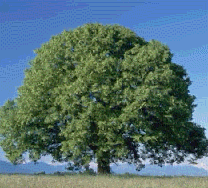

Lime
Lime (tree) or Linden, common name for a medium-size family of mostly woody flowering plants, and for its representative genus also known as basswood in North America. The family contains about 48 genera and 725 species of dicot trees and shrubs, which are distributed almost worldwide. It is important for its ornamental and timber trees and as the source of jute.
The family characteristically has alternate, simple, asymmetrical leaves. The bark is thick and fibrous. The flowers are solitary, paired, or borne in clusters and are frequently small, greenish, and usually scented. They commonly have five sepals (outer floral whorl), five petals (inner floral whorl), and many stamens (male floral parts) in groups of five or ten. The ovary (female floral part) is superior (borne above other floral parts) and matures into various kinds of several-seeded fruits.
The lime genus consists of 45 species widely distributed in north temperate areas, including valuable ornamental trees, and timber trees. The flowers are a major source of nectar favoured by honey bees. The common lime is a naturally occurring hybrid between the small-leaved and the large leaved limes and is often planted as a street and shade tree. It is prone to attack by pests and disease and is now being replaced by more resistant species. The small-leaved lime is native to most of Europe, including Britain. It has fragrant white flowers. The large-leaved lime is native to south-central Europe and has fragrant, yellowish flowers.
“Linden” is an old, alternative name for the lime tree. In America, limes are called basswoods and are an important source of timber. The fibre from the inner bark is used to make fishing nets, mats, cords, and shoes. Jute, used to make cordage and sacking, is principally derived from the stems of herbaceous white jute.
 |