Fern

Fern
Fern
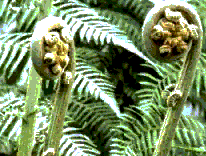
Fern, common name for any of a group of cryptogamous (spore-producing) vascular plants. The fern group (class) contains about 350 genera; estimates of the number of species range from 9,000 to 12,000. Ferns are found throughout the world. Most grow in damp, shady places, although certain species grow on dry ground or rocks. Some ferns, in fact, grow only in rocky places—in fissures and crevices of cliff faces and boulders. Others grow as epiphytes, or air plants, on trees. The earliest fossil remains of ferns have been found in rocks of the Lower Devonian period (about 408.5 million to 362.5 million years ago). The group thus appeared on Earth earlier than any seed-bearing plants. Ferns are among the oldest land plants. They were the dominant form of vegetation, together with clubmosses and horsetails, during the Carboniferous period (about 362 million years ago).
Ferns vary in size from those that are only a few centimetres tall to the tree ferns, which may reach a height of 24 m (80 ft). Tree ferns have trunk-like structures without branches, topped with clusters of feathery leaves, or fronds. Most ferns, however, have fronds that grow directly from a creeping or short upright stem.
The reproductive cycle of ferns consists of two generations, one asexual and one sexual. The asexual, or sporophyte, generation is the fern plant as it is commonly known. On the underside of the leaves, groups of spore cases, or sporangia, form. These can be observed as small brown spots, called sori. There are two major groups of ferns, the more advanced leptosporangiate and the more primitive eusporangiate. In leptosporangiate ferns, the sporangium is thin-walled and usually slender-stalked, and typically produces 64 or fewer spores. In eusporangiate ferns, the sporangium is thick-walled, lacks a stalk, and produces more than 1,000 spores. In many species all leaves are similar in appearance and bear sori. In others the fertile leaves which bear sori are very different in appearance from those that do not. Upon drying out, the sporangium breaks open and in many cases catapults the spores into the air.
When a spore falls in a place that has the necessary conditions of temperature and moisture, it begins to germinate, developing into a small, sexual fern plant, or gametophyte, called the prothallus. The prothallus is usually a tiny, flat, heart-shaped structure with a number of rhizoids (thread-like outgrowths) growing on its underside. Also on the underside of the prothallus are the sexual organs: the female organs, or archegonia, and the male organs, or antheridia. In certain species these organs develop on separate prothalli. Fertilization of the eggs in the archegonium takes place only in the presence of water. Only one sporophyte (asexual generation) plant develops from each prothallus, and after development has begun, the parent prothallus dies.
Native ferns and temperate species from other countries are frequently grown in gardens; ferns used as pot plants are usually tropical species.
 |