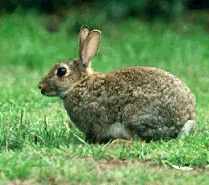
A rabbit

Distributed throughout the world, hares and rabbits have many common characteristics. Both types breed prolifically, bearing four to eight litters a year (with three to eight young in each litter), have a period of gestation lasting about a month, and have a lifespan of up to about ten years. These animals, which weigh from about 1 to 5 kg (2 to 11 lb) and attain a length of about 30 to 60 cm (12 to 24 in), feed usually at night, mainly on herbs, tree bark, and vegetables. They prefer to live in regions where the soil is loose and dry and where shrubs offer shelter. Although rabbits and hares are valued as game by hunters, as food, and for their fur, they are often pests to farmers whose trees and crops they destroy.
Rabbit
Rabbits and Hares, common name for certain small mammals of the Leporidae family. Although the names "rabbit" and "hare" are sometimes used interchangeably, in zoological terms the species called rabbits are characterized by the helplessness of their offspring (which are born naked and blind) and by their gregarious habit of living in colonies in underground burrows. (The exception is the cottontail of North America, which does not dig burrows; its nest is on the surface, usually in dense vegetation, and it is not social.) Species designated zoologically as hares are born with fur and open eyes, and the adults merely construct a simple nest and rarely live socially. Furthermore, a typical hare is larger than a rabbit, and has longer ears with characteristic black markings. The rabbit becomes sexually mature at six months, the hare at one year or, in some cases, two years. To a zoologist, the skulls of rabbits and hares are distinctly different.
A rabbit
Rabbits have been introduced to South America, Java, Australia, New Zealand, and various oceanic islands around the world. A significant instance of how fast rabbits can spread is shown by the present abundance of rabbits in Australia and New Zealand. Rabbits were first introduced into Australia in the late 19th century and into New Zealand in about 1860. They soon multiplied so rapidly that rabbit control became a serious problem. In Australia a virus deadly only to true rabbits was developed, and in 1951 decimation of the rabbit population began through the artificial promotion of this virus infection, known as myxomatosis. The project met with success only in areas with sufficient water to serve as breeding grounds for mosquitoes, which transmit the virus. However, the disease spread to Europe, killing rabbits in Great Britain, Belgium, and France, where the animal serves useful purposes.
 |  |  |