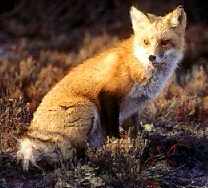
A red fox

Most foxes feed on mice, voles, rabbits, birds' eggs, fruit, large insects, and carrion (decaying animal flesh). Because their prey is small, foxes are solitary rather than pack hunters. They generally work territories of less than 8 sq km (3 sq mi), which they defend from other foxes. They are swift, agile runners; the red fox can reach a speed of 48 km/h (30 mph).
Red Fox
The red fox is by far the most common species of fox. It is 90 to 105 cm (36 to 42 in) long, not including the tail, weighs about 7 kg (15 lb), and is distinguished by black ears and feet, and a white tip on the tail. The coat is usually some shade of rusty-red or reddish-brown, sprinkled with light-tipped hairs. The red fox ranges across Eurasia and northern Africa and from northern Mexico to the Arctic. Within these vast zones diverse variations of the red fox have developed; those of the south are smaller and have lighter-coloured coats, and those of the north are larger, with thicker and darker coats. The silver fox, valued for its black fur speckled with white, is simply a variant of the red fox.
Fox
Fox , smallest member of the dog family, a group of mammals that also includes wolves, coyotes, and jackals. Foxes are characterized by short legs, a narrow elongated muzzle, erect triangular ears, thick fur, and a long, bushy tail. Foxes are found throughout the Americas, Eurasia, and Africa, inhabiting mostly forest, shrubland, and desert regions. Most of the ten species of the genus to which the red fox belongs can adapt to diverse climates and habitats.
A red fox
Scientific classification: Foxes belong to the family Canidae. The red fox is classified as Vulpes vulpes.
 |  |  |