
There is increasing concern about the survival of some of Britain’s rarest butterflies. The heat is on within all conservation organisations to manage for their various sometimes delicately balanced habitats, not always as easy or successful. Many of the Fritillaries are under threat due to the loss of managed woodland, coppices, grassy heaths and marshland since the war. Grazing with ponies can help to produce the floristic type of sward attractive to the nectar seeking adult and the food plants of the larvae. In High Brown Fritillary areas, the presence of large animals helps to maintain bracken, in a favourable condition by trampling and passage making. Roger Sutton, butterfly conservationist, makes the following comments regarding Haddon Moor, Somerset, the Marsh Fritillary and Exmoor pony grazing; -
"It is the Marsh Fritillary we are trying to save at Haddon Moor. As you will know the MF uses Devil's-bit Scabious and it is this plant we have been managing for on a wet Molinia heath.
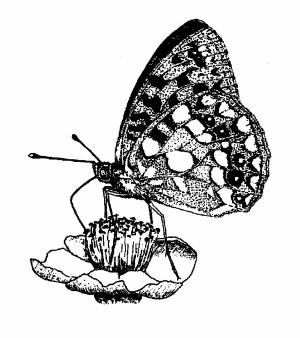
Unfortunately, however, there has yet been no break-back in the numbers of MF responding to this improvement and the decline continues. The weather at flight times was terrible so we may simply have been dogged by bad luck, although on a day when none were seen in a two hour search, twenty four were seen at nearby Huish Moor.
As well as MF we have Pale Butterwort, Petty Whin and Small Pearl-bordered Fritillary, all of which have responded favourably to the grazing. We are wondering if like the Holly Blue recently, the MF may be on a downward spiral connected with parasitism(?) ...although there has always been something 'wrong' in the habitats we know of in which they have nearly or actually become extinct. At Haddon this year it was the weather because it is a high and very exposed site."
 |  |  |