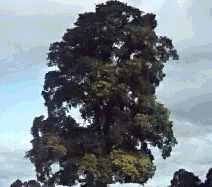

Elm
Elm, common name broadly used for trees and shrubs of a family widespread throughout the North Temperate Zone. The tall, deciduous trees of the representative genus (true elms) have straight-veined elliptic leaves. The inconspicuous purple or yellowish flowers bloom in clusters and appear before the leaves unfold.
The English elm, a true elm, grows up to 30 m (100 ft) tall; occasional specimens are much taller. It is found throughout western Asia, Europe, and northern Africa. The wood is compact, durable, and water-resistant and is used for the manufacture of numerous items. The outer bark is used medicinally; dyes are also made from it. The hackberry or nettle tree genus, which is in the same family, contains about 80 species of trees and shrubs, some of which produce edible fruits. They are often planted for ornament and shade.
One of the most common elms is the Wych elm, a broad, spreading tree which often grows to 40 m (130 ft). The Dutch elm is very similar to the Wych elm. A smaller tree is the small-leaved elm, which is very varied and the many distinctive local populations are often given individual names such as Cornish elm and Jersey elm.
In recent years the elm population in the United Kingdom and other countries has been markedly decreased by Dutch elm disease. No effective control has been discovered for it, although some species of elm are resistant to the disease. The Caucasian elm, which belongs to a related genus, is not affected by Dutch elm disease.
Scientific classification: Elms make up the family Ulmaceae. The English elm is classified as Ulmus procera.
 |  |  |