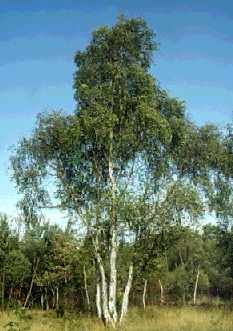

Silver Birch
Birch, common name for a family of woody trees or shrubs that produce abundant, tiny male and female flowers in separate dense clusters. The family (see Beech) is widely distributed in temperate and Arctic regions of the northern hemisphere, and is also found on some tropical mountains. The family contains six genera and about 150 species.
Trees of the Birch genus produce close-grained wood of uniform texture that is used in making furniture, flooring, plywood, and veneers. The trees have thin bark that often peels horizontally. Birch beer, once a popular drink in North America, is derived from the sap. The bark of paper birch was used by Native Americans to build canoes. The bark was also used as writing materials in the Himalaya, and as food during famine in eastern Asia. Oils and dyes can be made from birches. Several species are useful ornamentals-for example, the silver birch, which has many horticultural varieties. The genus Corylus is the source of hazelnuts and filberts, which have been used as food since ancient times.
The family also contains alder, hornbeam, and hop hornbeam, among others. Most are shrubs or short-lived trees that are too small when mature or are otherwise unsuitable as a source of useful timber.
Members of the birch family exhibit several adaptations to fertilization by wind pollination, which is common throughout the group. Separate clusters of male and female flowers are produced on the same plant, developing in the autumn and maturing in the early spring. Sepals and petals are very small or entirely absent, exposing the pollen-bearing stamens and pollen-collecting pistils to the wind. Enormous quantities of small, easily wind-dispersed pollen grains are shed in the spring by male flowers. The female flowers, however, are not fully mature when the pollen is shed; the styles and pollen-receiving stigmas have formed, but the ovules, which must be fertilized to mature into seeds, have not formed. The pollen remains lodged in the tissue of the styles for several weeks while the ovules mature. Fertilization and seed production follow this process.
Scientific classification: Birches make up the family Betulaceae, of the order Fagales. The silver birch is classified as Betula pendula, the paper birch as Betula papyrifera, and the sweet birch as Betula lenta. The hazelnut and filbert are classified in the genus Corylus. Alders are classified in the genus Alnus.
 |  |  |