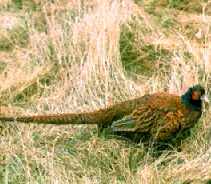
A pheasant

In all of the subspecies of the common pheasant, the male has a naked red face and wattles, two short "horns" of feathers at the back of the crown, and a very long, barred tail. Body colour is highly variable; for example, the rump of the Chinese ringneck is pale whitish-green, that of the Mongolian bird maroon. Males are about 90 cm (35 in) long. Females, which are buff-coloured below, mottled with brown and black above, are about 63 cm (25 in) long. In Europe and North America, many common pheasants are reared on game farms and released for hunting. They do best in open country and are especially abundant in fields planted with cereal crops. A white-winged subspecies from a more arid region of Asia has been successfully introduced into the south-western United States.
The males of many other pheasant species have bright, ornamental plumage and are readily bred in captivity; some of these have been liberated, but none has succeeded as well as the common pheasant. For example, there are populations of the golden pheasant of central and southern China in Britain, and of the kalij pheasant of the Himalaya on the island of Hawaii.
Pheasant
Pheasant, common name for about 50 species of birds, including such well-known examples as the peacock and jungle fowl. All pheasants except the Congo peafowl of Africa are native to Asia, but several species have been introduced elsewhere.
The best-known species is the common pheasant, often called the ring-necked pheasant because of the white ring on the neck of males of several of the 34 subspecies. The female is much less conspicuous, with mottled brown plumage and a shorter tail. The pheasant, originally introduced into Europe from Asia in about AD 500, was a ringless subspecies from the eastern side of the Black Sea.
A pheasant
Scientific classification: Pheasants belong to the family Phasianidae, order Galliformes. The common pheasant is classified as Phasianus colchicus.
 |  |  |